Tuesday, March 13, 2018

Four times the minimalism!

Saw this little roll-a-round souvenir stand at the henequen / sisal hacienda Sotuta de Peon -- a really interesting place.

All the sisal based knick knacks were cool and we bought a couple, but what really caught my interest was the stand itself: four bicycle front forks and wheels.  About as simple as it can get.

Knew it reminded me of something.  Eventually realized what, and also who.  Bicycle Wheel, Marcel Duchamp, 1913.  DuChamp was a pioneer of minimalist art and Dada movement.  "Duchamp's insistence that art should be an expression of the mind rather than the eye or the hand spoke to Minimalists and Conceptual artists alike."

Marcel Duchamp and Bicycle Wheel:


Souvenir Seller and Push Cart with Four Bicycle Wheels:


Dada movement is associated with concept of absurdist art.
Oxymoron "Four times the minimalism!" is my own small contribution.


Friday, March 2, 2018

Green Gold


"Sisal, with the botanical name Agave sisalana, is a species of Agave native to southern Mexico... It yields a stiff fibre ... traditionally used for rope and twine ... because of its strength, durability, ability to stretch, affinity for certain dyestuffs, and resistance to deterioration in saltwater. The importance of this traditional use is diminishing with competition from polypropylene..."  -- Wikipedia

Wikipedia is not entirely right.  Agave sisalana yields a fiber called henequén.  Henequén was shipped as bales of raw fiber to international buyers, exported through a small Mexican port named Sisal.  The bales were all stamped with the port name -- so the world came to call the fiber "sisal".

Sisal is worth little today, but picture the world in the latter 19th.  Huge transportation demand due to a booming global economy.  Most international trade was on ships, which require a lot of rope.  Sisal makes terrific rope.  Sisal grew in one location in those days -- the Yucatan -- putting growers in a nice situation. A labor intensive product, but costs were kept low through a labor system that was slavery in all but name.  Sisal got the nickname "green gold", and money flowed steadily into the Yucatan.  Funded hundreds of production haciendas, and some very nice in-town homes for the owners.
Mid 20th century inventions of nylon and polypropylene essentially killed the sisal market.  Geographic monopoly was destroyed by the sale of plant stock to other countries.  What market remained was taken over by even lower cost producers, notably Brazil.  
Sisal is still a terrific organic twine, but how much does the world need?
This historic hacienda is essentially a hobby farm, kept open by a family with significant banking interests.  They are trying to find some economically viable uses for sisal to reinvigorate the sisal trade and the region.


Monday, February 26, 2018

No debemos olvidar...

Lived in shorts and short sleeves for a month.  Heading home soon.  Posting this as a future reminder that warm weather is out there...


Sunday, February 25, 2018

Mérida Unplugged - Santiago park, Friday night


Other end of musical spectrum in Mérida. Up till about 9:00 a guy gives guitar lessons to local students.  After 9:00, a group of amateur musicians and dancers practice and perform.  Though they take donations, it's pretty clearly not a commercial thing -- they are in for the fun.


Dancers provides the percussion.  Combination of flamenco and tap dance?  On wooden pallets that serve both as a dance floor and an acoustic amplifier.

Guitars are really interesting.  Very small body acoustics, generally short scale lengths, but up to 12 nylon or gut strings.  Mainly a rhythm instrument.

And a jawbone / stick combo for rhythm also.  Called a "quijada" or "charrasca".  Made from jawbone of a donkey, horse or mule.  Makes a cool buzzing sound when you run the stick over the teeth.


Video clip:


Thursday, February 22, 2018

Low rent rock and roll

Corner about two blocks from our house.  By day a decrepit old store, for sale.  After dark, a music studio where six musicians practice.  We walked by a couple nights ago, heard them playing blues classic "Bad Bad Whisky".  Last night, Stones "Wild Horses" and "Jumping Jack Flash".  Hope they are practicing again tonight!   Short video clip with sound, below.

Wednesday, February 21, 2018

Coincidence?

Can probably sense from last post that I wasn't happy with Valladolid.  I wasn't.  It was a place with an overall bad feeling, and our apartment was infested with black mold, and Katie lost a personal item.

Day to day I'm pretty much a skeptic on supernatural.  But this a true story (a happy one!) from Valladolid.  It is the kind of thing that makes the hair on back of neck stand up a bit, since the odds of it happening seem to be on the order of say 1 zillion to 1... or essentially impossible.

One of us had a cough.  A few days earlier honey had been recommended as a treatment (hot water, honey, squeeze of lime).  But we had no honey.  We were wondering where we could find a store that sold honey.  We were sitting in a little lunch counter kind of place, when an older woman walked up.  She seemed to speak no English, with Spanish only as a second language -- she spoke local Yucatecan as primary language.  She had one very small bag, from which she pulled a recycled 12-ounce bottle filled with honey, along with two smaller bottles of honey-based spice mixture.  That was her total inventory.  She asked us "Mielo? Setenta pesos?"  We said no thank you pretty much by reflex and she walked off.  We then said to each other "Did she just offer us a jar of honey??"  She walked back, and said "Sesenta pesos?"  And we bought it.  It was terrific honey.

When was the last time you were looking for something so specific as a jar of honey, and a stranger walked up and asked if you would like to buy hers?  Just does not happen.

Valladolid was that kind of place, but not all the vibes were so positive.  So we followed our instincts and left.


Tuesday, February 20, 2018

Back from Valladolid

Planned 3 nights in Valladolid, but returned to Mérida after 1.

Valladolid has a terrific cenote! 
Other than that... well... this post may be short.

 Semi-subterranean cenote, you walk down into a cave...


Sunday, February 18, 2018

Dzibilchaltún

An excellent archeological site very close to Mérida, with a terrific cenote for swimming and cooling off.

Name means "place of the stone writing" in Mayan, but the name is a tongue twister.  No disrespect intended, but as Katie and I were talking about it and planning a visit, we had to find a name we could pronounce.  So in place of Dzibilchaltún we call it BzBzBz (pronounced bzzbzzbzz). 

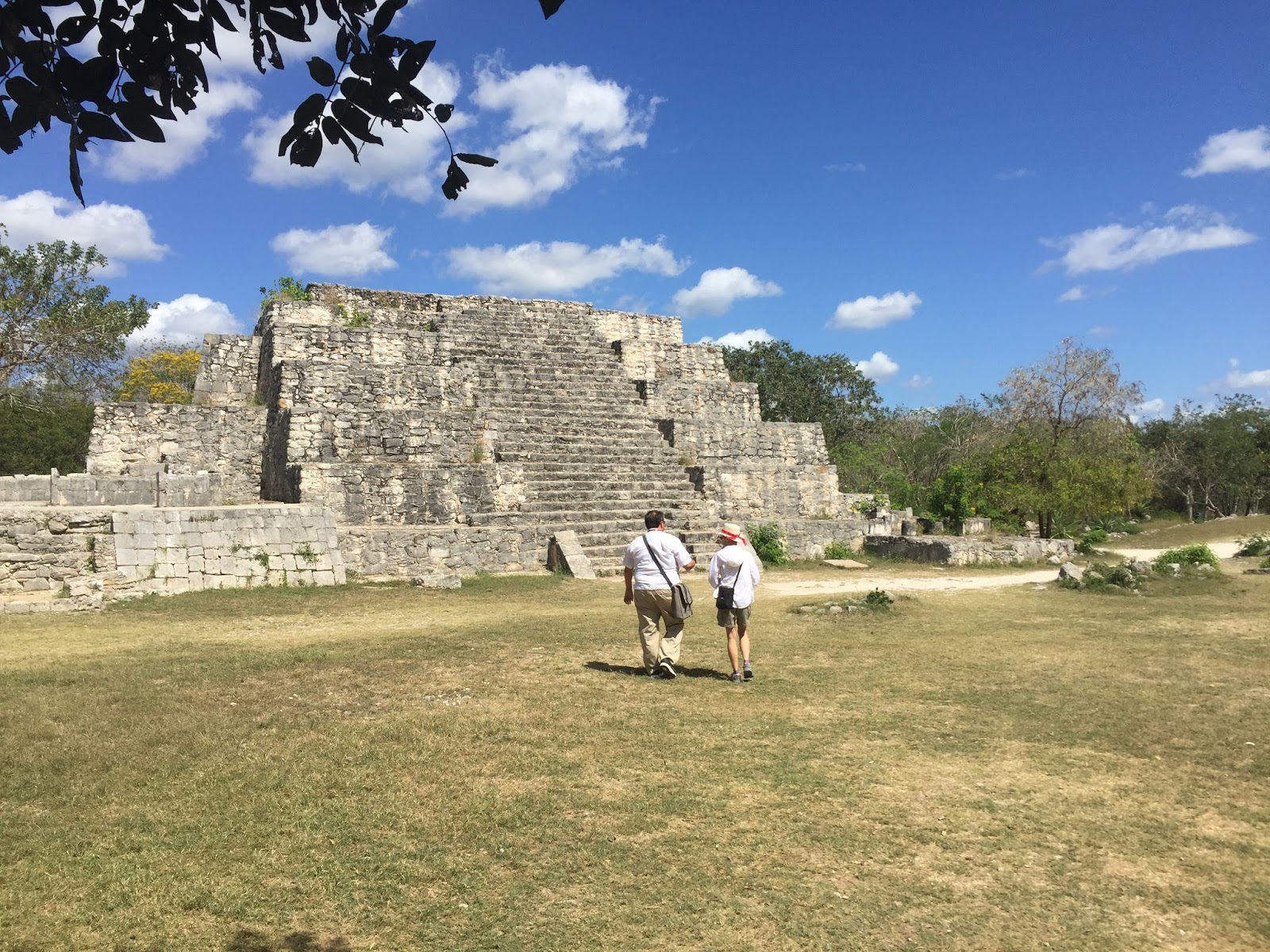
Short thumbnail history.  Dzibilchaltún is only ~15 miles from Mérida, the largest city in Yucatan. And the site is huge: 15 square kilometers, with more than 8000 Mayan buildings identified since its "discovery" in 1941.  Only half a dozen buildings excavated so far -- much of this site is nearly pristine, still covered in vegetation.  How did this happen???  How did it stay unknown until 1941?

Answer is ironic.  It wasn't unknown.  It was forgotten.  Conquistadors began "development" of the area about the same time as Mérida, early 1500s.  In this case, "development" meant granting this huge piece of land to one family, who immediately began to tear down the most convenient Mayan buildings and use the stones to build a church.  But here is the kicker: after a few years the family decided that Mérida was where it was happening, so they moved to the city... and left their land grant (Dzibilchaltún) essentially abandoned and ignored for the next 400 years.  Yes, a time capsule, made possible because some conquistador said "Jed, Mérida's the place you ought to be..."   Meanwhile, they abandoned construction of the Christian church they had begun on their hacienda... so it became a ruin, among the older ruins.  The site then sat unmolested for 400 years.

Katie and Mimo
We benefited from the knowledge of a terrific guy (nickname, Mimo) who was available as a guide.  So glad we met him.  He had, for example, photos he had taken of sunrise on the solstice shining through the window of a key temple building.  Doesn't sound like much but it is pretty beautiful.

Plus, a wonderful cenote.   
In simplest terms, cenote is Spanish for swimming hole.


Katie, Mimo and Pyramid
Ruins of the abandoned Christian church project...

Cenote


Saturday, February 17, 2018

Stone Recycling

Good building stones are hard to come by -- they are heavy and take a lot of work to prepare.  And they don't generally wear out.  Prime candidates for recycling.

Mérida had 5 stone pyramids in 1500, before los conquistadores arrived.  We don't know exactly what they looked like since nobody took a photograph.  By 1600, Mérida had zero pyramids but a new cathedral, a house for the family of top conquistador, a house for the governor, and a big town hall forming the borders of a central town square.

So, it seems the sacred stones of the pyramids became the sacred stones of the cathedral (and the secular stones of some other nice real estate).  Lot of hard work involved, and my guess is the conquistadors took mainly a supervisory role.  And I get the impression that fair wages were not a consideration.

Today, once a week the faces of the cathedral and of the conquistador house serve as screens for amazing light shows.  The shows are beautiful, technically tough (they have to have really tight registration of the laser projection on the features of the walls), historically informative and kind of spiritually uplifting. 

From the show "Sacred Stones", projected on the cathedral.


Thursday, February 15, 2018

Great vocabulary that you don't use everyday...


Imagine my delight to see this product and have the vocabulary to recognize it!

  I knew guano from some ultra boring junior high geography lesson ("... the key export of ____ is seagull guano...").  And of course Lamborghini makes the Murcielago, named because it goes like a bat out of hell.  

But finding guano de murcielago as a commercial product? Is this what Stephen King uses to grow his characters from slightly neurotic individuals to batshit crazy ones?

For my inner 13 year old, language study just doesn't get much better.